LoggFi · Pharma · India
Temperature monitoring for pharmaceutical storage
Pharmaceutical temperature monitoring starts with the storage conditions of the products in your care. LoggFi offers connected temperature and humidity logger options for evaluating a facility’s monitoring requirements. Define the equipment, measurement range, calibration points and records with your quality team before selecting a model.
01 · The application
Where to plan your monitoring
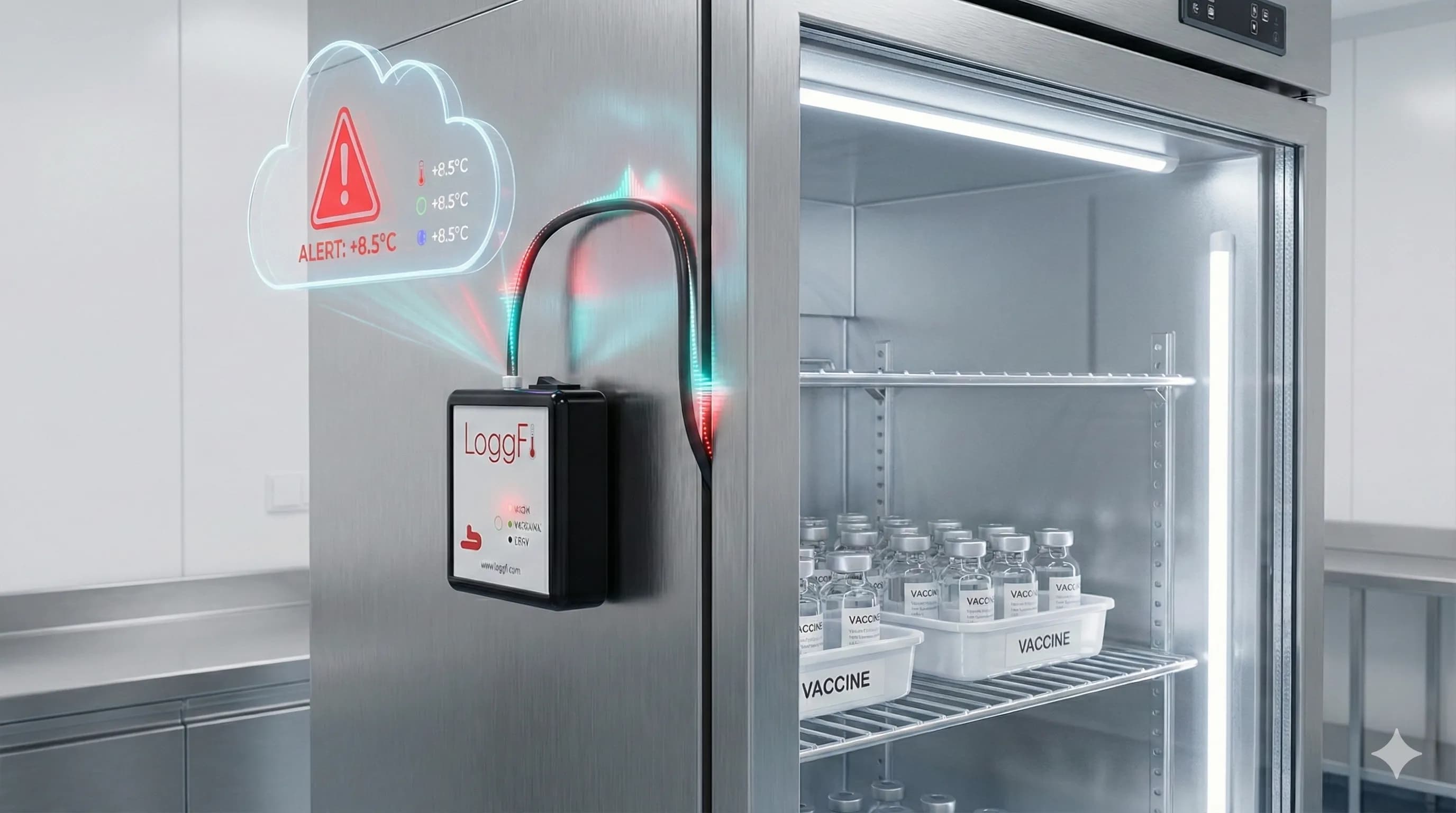
Medicine refrigerators
Give each refrigerator a clear identity in the monitoring plan. Agree the probe position, product limits and cover for out-of-hours notifications. Include the refrigerator’s own controls and alarms in your operating procedure.
Pharmaceutical warehouses
Use the facility’s mapping results and risk assessment to choose routine monitoring locations. A convenient wall position or a single central sensor may not represent the storage locations the quality team needs to observe.
Temperature and humidity stores
Where the product requirements include humidity, specify both measurement needs and their calibration documentation. Establish how the team will review changes during loading, seasonal conditions and air-conditioning interruptions.
02 · Before installation
Agree the requirements before qualification
Product and location scope
List the storage areas, product-labelled conditions and monitoring locations selected through your facility’s qualification process.
Calibration evidence
Specify measurement points, certificate scope, traceability needs and the recalibration plan. Catalogue accuracy is not a substitute for an appropriate certificate for the supplied assembly.
Data and access requirements
Ask for a demonstration of user access, available records, report formats and retention arrangements. Confirm any audit-trail or validation requirements explicitly before purchase.
Acceptance observations
Document a controlled reading, upload and notification test. Agree how a power or network interruption will be tested and what evidence the quality team will review.
03 · People and records
Build an excursion review around the stored products
Verify the observation
Identify the storage unit, sensor, timestamp and affected period. Establish whether the record is current or delayed by a connection interruption.
Escalate to the quality owner
Follow the approved deviation procedure and use the relevant product information for assessment. The logger does not decide whether medicines remain suitable for use.
Document and restore
Keep the readings, assessment and authorised actions together. Confirm equipment conditions and monitoring operation before returning to the routine review process.
04 · Catalogue options
Match the sensor to the requirement
LoggFi
NTC · −40°C to +50°C
Evaluate NTC temperature models for storage conditions within their range, with calibration points appropriate to the intended products.
Compare LoggFi optionsLoggFi Hygro
NTC & SHT20 · −40°C to +50°C
Evaluate a Hygro model where both temperature and humidity must be monitored. Confirm the humidity accuracy and calibration scope for your requirement.
Compare LoggFi Hygro optionsLoggFi+ PT100
PT-100 · −200°C to +400°C
Discuss PT100 for storage temperatures outside the core NTC range, subject to the supplied probe assembly and qualification needs.
Compare LoggFi+ PT100 optionsRanges above come from the LoggFi catalogue. Confirm the supplied probe and calibration scope. The listed electronics environment is 10 – 40°C · 30 – 70% RH; a sensor range does not describe enclosure suitability.
Choose the connection separately: WiFi models use facility internet, while listed GSM models need compatible GSM/GPRS (2G) service. Remote readings and notifications depend on power, connectivity and the configured service. Use the wireless installation guide to plan outages and acceptance tests.
Pharma monitoring questions
Is temperature mapping the same as routine monitoring?
Mapping studies temperature distribution across an area under defined conditions. Routine monitoring follows selected locations over time. Use your mapping and qualification findings to justify the ongoing monitoring positions and review them when the facility changes.
Can LoggFi monitor a vaccine refrigerator?
Discuss the exact vaccine programme, equipment and procurement requirements before choosing a device. A temperature range alone does not establish programme eligibility or WHO prequalification. Confirm required device approvals and documentation with the purchasing and quality teams.
Does the platform meet our electronic-record requirements?
Request a demonstration against your written requirements for access, records, retention, audit trails and validation. This page does not establish 21 CFR Part 11 compliance or validated-system status; obtain evidence for each requirement before accepting the system.
Your next step
Discuss pharma monitoring
Share the details below with the LoggFi team in Kochi. Ask for the device, cloud service, calibration and installation costs to be itemised for your requirements.
Request a pharma quote- Storage areas and equipment
- Product-labelled temperature and humidity limits
- Mapping findings and monitoring-point count
- Calibration and qualification documents required
- Record, access and retention requirements