
LoggFi · Food & beverage · India
Temperature monitoring for food storage
A food temperature data logger records conditions over time in a refrigerator, freezer or storage area. LoggFi WiFi and GSM models let your team review uploaded readings and configured notifications. Start with the food being stored, its approved limits and the points where a change could go unnoticed between manual checks.
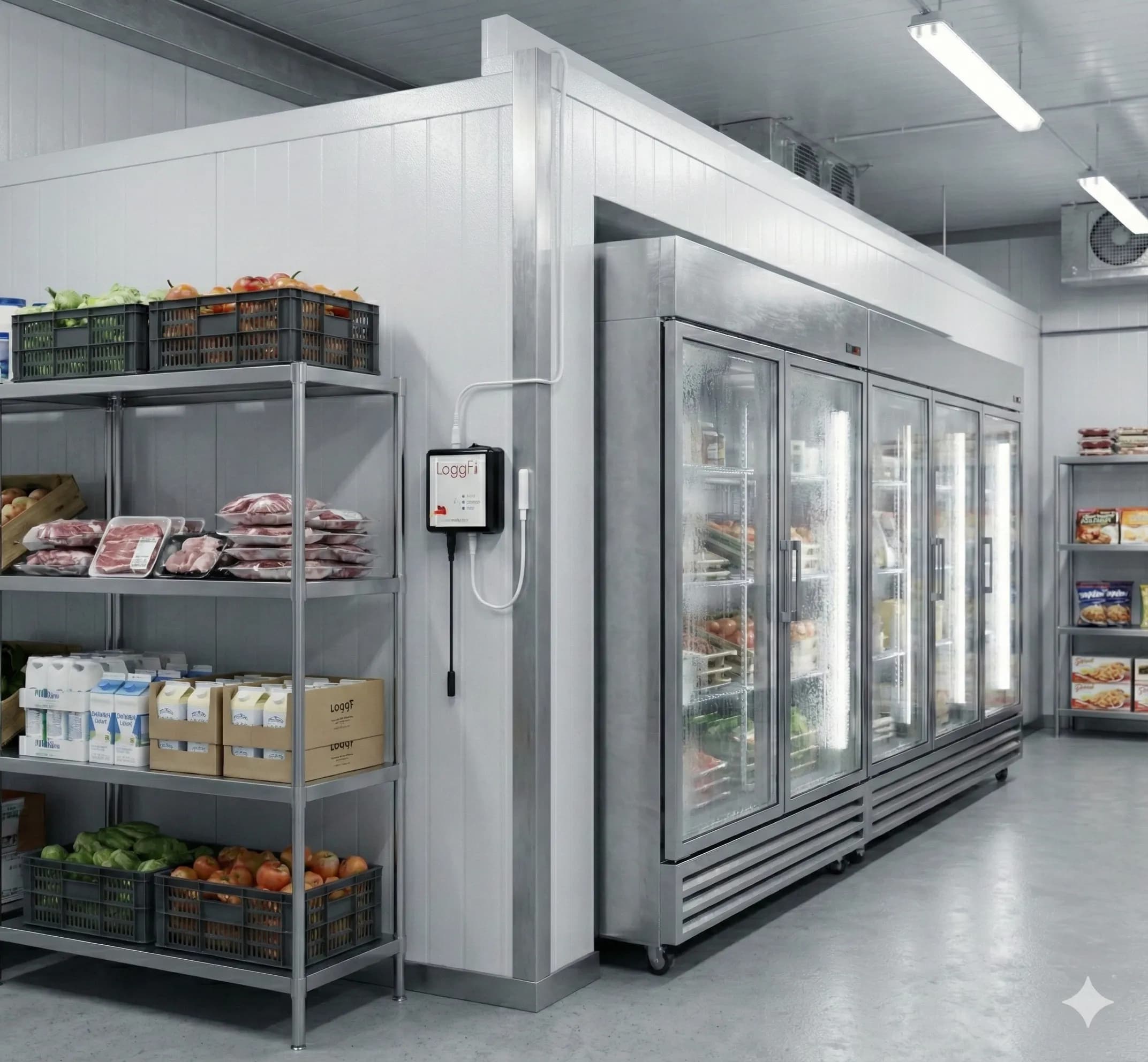
01 · The application
Where to plan your monitoring
Chilled ingredients and finished goods
Keep each monitored area identifiable by room, cabinet or equipment number. Connect the temperature record to the stock and shift records your team already uses, so an excursion can be investigated in context.
Frozen storage
Specify the lowest working temperature and expected defrost conditions before selecting a probe. Review how loading, door openings and defrost cycles appear in the record before setting the response procedure.
Receiving and dispatch
Use room monitoring alongside the product and delivery checks defined by your food-safety plan. A loading-bay air reading does not establish the temperature inside every incoming pack.
02 · Before installation
Prepare a food-storage monitoring brief
Separate the food categories
List the chilled, frozen and ambient products, their approved limits and the equipment used for each. Avoid applying one threshold to the entire site.
Define what the probe measures
Agree whether the task is storage-air monitoring or a product measurement. Confirm the probe assembly, mounting, cleaning and any food-contact requirements with the supplier.
Check the working environment
Plan cable routing around doors and cleaning activities. Keep the logger electronics within their catalogue operating conditions; confirm protection against moisture and washdown exposure.
Connect alerts to a shift owner
Name a primary and backup recipient. Test the notification path during a controlled setup check and record who reviews readings outside business hours.
03 · People and records
Turn a temperature excursion into a traceable review
Identify the period
Record the equipment, time and affected stock locations. Check the reading timestamp and whether uploads were interrupted.
Follow the food-safety procedure
Ask the responsible team to assess the event using its approved limits and disposition process. A logger reading alone cannot establish food freshness or release stock.
Keep the investigation together
Retain the relevant temperature record with stock movements, equipment observations and the action taken. Include a demonstration of your required report format before ordering.
04 · Catalogue options
Match the sensor to the requirement
LoggFi
NTC · −40°C to +50°C
Consider the NTC family when its listed range covers your refrigerator or storage-room conditions. Choose WiFi or GSM after checking the actual installation point.
Compare LoggFi optionsLoggFi+ PT100
PT-100 · −200°C to +400°C
Discuss PT100 when the required range extends beyond the NTC family. Probe construction and installation suitability still need confirmation.
Compare LoggFi+ PT100 optionsRanges above come from the LoggFi catalogue. Confirm the supplied probe and calibration scope. The listed electronics environment is 10 – 40°C · 30 – 70% RH; a sensor range does not describe enclosure suitability.
Choose the connection separately: WiFi models use facility internet, while listed GSM models need compatible GSM/GPRS (2G) service. Remote readings and notifications depend on power, connectivity and the configured service. Use the wireless installation guide to plan outages and acceptance tests.
Food & beverage monitoring questions
What temperature should a food logger alarm at?
Set limits from the requirements for the particular food, process and storage equipment. Have the food-safety team approve thresholds and the response procedure; there is no single setpoint for every food business.
Can a storage logger replace a food probe thermometer?
They answer different measurement questions. A fixed probe records conditions at its installed position; it does not measure every delivered item or the core of every product. Keep the product checks required by your procedures.
Does installing LoggFi make a site FSSAI compliant?
Installation alone does not establish compliance. Monitoring records are one input to your wider food-safety system. Confirm the applicable requirements, calibration documentation and recordkeeping with the person responsible for compliance.
Your next step
Discuss food-storage monitoring
Share the details below with the LoggFi team in Kochi. Ask for the device, cloud service, calibration and installation costs to be itemised for your requirements.
Request a food & beverage quote- Food categories and storage equipment
- Approved temperature limits
- Number of monitoring points
- Cleaning and probe-placement requirements
- Shift contacts and record requirements